THE CLOCKOne audit · one evaluation · one month apart
The Round Trip
This site argues that Canada never joins its records. On private money, it did: FINTRAC
took in 65.1 million reports in 2024–25, and joining them is its whole job.
A police service asks a question, and on the Auditor General's count the answer takes
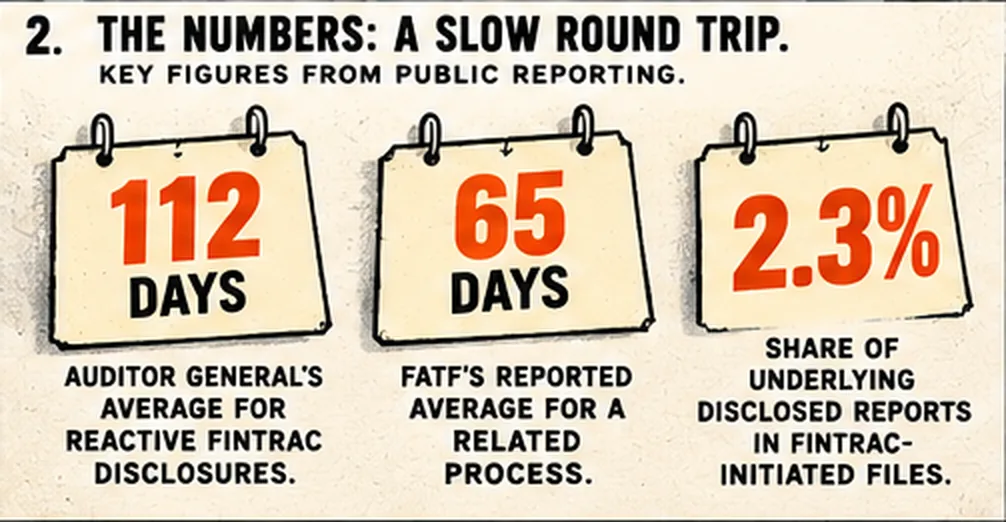
112 days. The Financial Action Task Force counted 65. The two reports
came out a month apart, disagree on the number and agree on the verdict. No statute sets a limit.
FINTRAC publishes no figure of its own.
112 days
Auditor General's average, reactive disclosures
65 days
FATF's average, and “not considered timely”
2.3%
Share of disclosed reports in proactive files
0
Time limits in s.55 of the Act
The road
It leaves from the police station, not the bank
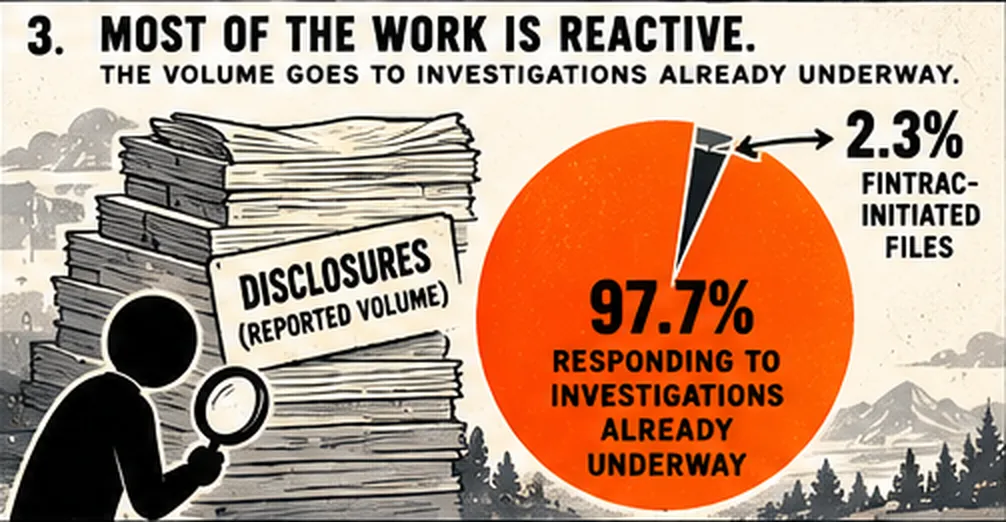
The usual picture runs one way: banks report, FINTRAC analyses, police act. That road exists. It carries under a quarter of the files.
In 2024–25 FINTRAC produced 2,730 unique disclosures. Its annual report sorts them by what started each one.
1,771 began with a voluntary information record from a Canadian police or security agency. 337 began with a foreign intelligence unit. 622 began inside FINTRAC.
By file
65%12%23%
65% Canadian agency request · 12% foreign unit · 23% FINTRAC's own initiative
By the reports inside them
83%15%
11,956 of 511,480 reports sat in proactive files: 2.3%. A request-driven file averages 240 reports. A proactive one averages 19.
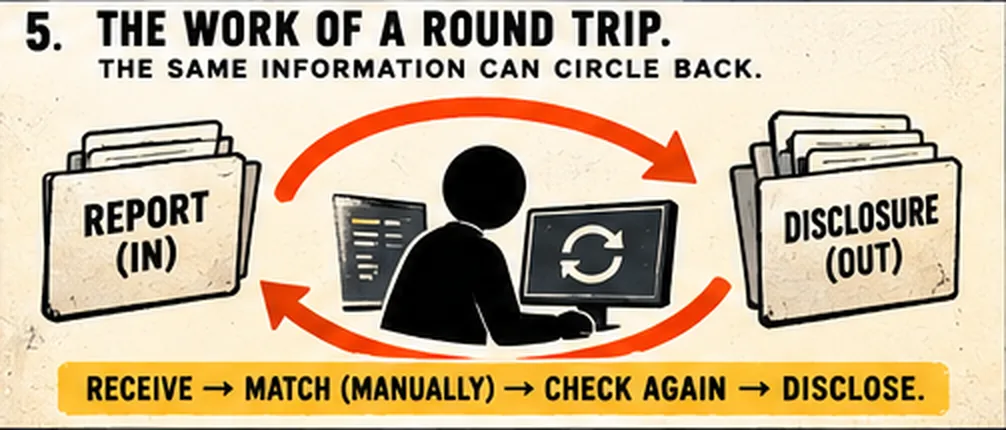
So the 112-day figure measures a return trip. Police already have the suspect, send what they know, and wait for FINTRAC to send back what it holds. Exhibit 4 of the audit walks exactly that: a municipal drug case, a voluntary record, a database comparison, a disclosure, a production order.
The clocks
Two reports timed the same trip and got two answers
The Auditor General and the Financial Action Task Force each put an average on the wait. They are 47 days apart.
75
37
112 days
Reactive disclosures, January 2023 to June 2025. 75 days building the content, 37 on the legal test and three levels of approval. OAG para. 33
FATF's 65 comes with a trend: the average fell from 80 to 65 days across its review years. The auditors' window sits inside those same years and lands on 112. An average running from 80 down to 65 does not contain a 112, so these are two different counts of one process. Neither report states the difference, and the agency that holds the records has published no count of its own. The Logic reported that FINTRAC provided no updated average.
The auditors found why nobody at FINTRAC could settle it: it did not actively monitor the timeliness of its reactive financial intelligence or establish internal service standards. The agency's spokesperson, Darren Gibb, told The Canadian Press that this can be done in less than an hour when it is urgent. FATF's urgent figures are the ones on the record: about 40% in under ten days, the rest averaging about 27.
The 23
The headline number is right, and it undersells the drop
FINTRAC finds fewer new things on its own, and the things it finds are small.
Year
Auditor
FATF
Gap
2021–22
38%
39%
match
2022–23
26%
27%
match
2023–24
19%
19%
match
2024–25
23%
33%
10 pts
The auditors' fall from 38% to 23% bottoms at 19% in 2023–24 and rebounds. FATF's table agrees for three years, then reads 33%. FINTRAC's annual report settles it: 622 proactive files of 2,730. FATF's table counts domestic disclosures only and carries 878 on the proactive side, and the arithmetic lands there: 622, plus 337 files that began with foreign units, less 82 sent abroad, is 877. Twenty-three percent is the figure for FINTRAC's own initiative.
The share also flatters the work. Proactive files are 23% of disclosures and 2.3% of the reports disclosed. The institution with sole access to 65.1 million reports a year spends nearly all of its disclosed volume answering questions police already had. In the audit's survey, 35% said proactive disclosures usually led to new investigations.
The 75
The joining is done by hand
The first 75 days go to the work this whole site says Canada lacks.
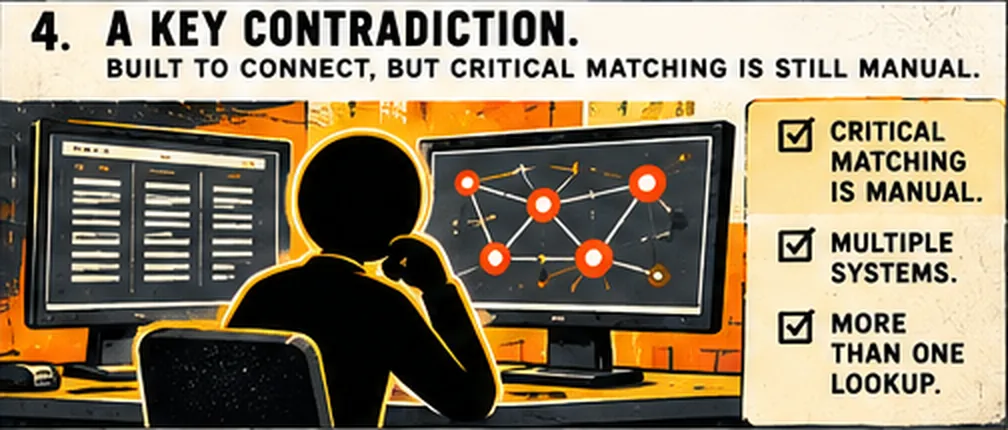
Bank A files “John Smith, 123 Main St.” Bank B files “J. Smith, Ottawa.” A currency exchange files “John A. Smith, 122 Main Ave.” Deciding those are one man is entity resolution. Mapping who paid whom is network visualization. The audit calls them FINTRAC's two critical processes, and found both carried out manually, often taking several days, with software for them already on the market.
Finished work was not kept. Results were not stored in a centralized system for use by other analysts, so analysts redid each other's joins. This is the fragmentation problem again, inside the one institution built to end it.
The load grew 80% in the threshold reports, from 35.7 million to 64.5 million in two years. Suspicious transaction reports, the ones built on a person's judgment, grew 13%.
The fix was funded in 2022: $29.6 million over five years. By February 2026 FINTRAC had spent $13.3 million, or 45%, and could not say what the project would cost or when it would end. First deployment is promised for winter 2026–27. Meanwhile goAML, the United Nations' software, runs in more than 70 countries at US$149,000 to US$250,000 in its first year. The audit found FINTRAC never considered or inquired about it. FINTRAC's reply: no bid was submitted.
The 37
Banks have a deadline. FINTRAC does not.
The second stretch is the legal test and the sign-off. Part of it is real work. All of it runs without a clock.
Now
A listed person's propertyThe reporting entity sends it immediately. STR Regulations s.10(2)
Soon
A suspicious transactionThe entity reports as soon as practicable once it can establish reasonable grounds. STR Regulations s.9(2)
None
FINTRAC to policeThe Centre shall disclose once it has reasonable grounds to suspect. Section 55 sets no time. PCMLTFA s.55(3)
The 37 days hold two things: deciding whether the statutory threshold is met, and three levels of approval. The threshold is the safeguard Parliament wrote. The audit says the approval layers contributed to the delay. Both are inside the number, and FINTRAC reports neither one on its own.
Asked for service standards, FINTRAC agreed to set “internal service targets” within six months. Internal is the operative word. A police service still will not know when to expect an answer.
The verdict
The defence cites a report that convicts it
FINTRAC answered the audit with the FATF evaluation. FATF wrote the sharper sentence.
Auditor, 29 Oct
FATF, 29 Sep
Rating
“did not carry out compliance oversight and the generation of actionable financial intelligence in an effective manner”
Financial intelligence: Substantial. Investigations and prosecutions: Moderate.
Speed
112 days. Half of respondents: too late to be useful.
65 days. “Overall, FINTRAC is not responding to general VIRs in a timely manner.” para. 472
Quality
Adequate and easy to understand, per the same respondents.
“High quality operational and strategic intelligence.”
The reports look opposed because they grade different things. FATF scores a whole system, and the system includes police who work around the delay. FATF says so: police increasingly rely on alternative proactive intelligence gathering techniques, and key agencies build a substantial share of their own financial intelligence. Police route around the queue, and the route around it counts toward the Substantial.
The survey behind “half” went to 130 recipients, drew a 36% response, about 47 people, and the audit itself calls it not statistically representative. FINTRAC raised that, correctly. The heading “Half of the time” turns half of the respondents into half of the disclosures. The verdict does not rest on that survey: FATF reached it from a different record.
What comes back
Mostly, police learn what they already knew
Two percentages near 95 sit on top of this record. Neither measures what it sounds like.
94%
FINTRAC: used in 94% of investigationsThe FATF text: a small random sample of RCMP Federal Policing cases. paras. 504, 526
95%+
FINTRAC: more than 95% actionableOne yes on any of five questions counted, with about 3% of recipients answering. Auditors reading the comments moved a sample from 93% positive to 76%. OAG paras. 67–68
81.9%
Reactive files that confirmed what police knewFATF: FINTRAC's full capability is not being sought to the full extent. para. 492
10%
Disclosures that triggered a new investigationOf those with feedback, proactive and reactive combined. para. 491
8%
RCMP cases started by a proactive disclosureSame small sample as the 94%. para. 526
Both reports use the same feedback forms and report two response rates: about 3% against about 11%. The gap is the denominator. The auditors divide by disclosure packages, one per recipient: 6,236 in 2024–25 alone. FATF divides by unique domestic disclosures: 10,127 across five years.
FATF's fix for the corroboration problem is the most useful sentence in either report: give police a searchable, self-service repository, so simple checks stop waiting in line and analysts get the time back. Most of the queue is fact-checking.
The end of the line
Then the money charge is dropped
Speed matters only if something waits at the end of the road. Here is what waits.
FATF rates this stage Moderate. Over its review period police ran 3,173 investigations for laundering proceeds of crime, and 1,585 such charges were laid. The RCMP's share was 1,234 investigations and 156 charges. Those are FATF's agency counts, and they count investigations and charges, not one case followed through.
At prosecution, laundering charges are frequently withdrawn to secure convictions for predicate offences. FATF calls that lawful and useful, and says it is occurring at the expense of convictions for ML. When FINTRAC sought follow-up on 162 disclosures to the RCMP, CRA and CSIS from 2020 to 2024, the outcomes reported were 30 charges and 10 convictions.
That is the whole road: a transaction that clears in seconds, a report filed as soon as practicable, a wait with no limit, a sign-off, a confirmation of what police knew, and a charge traded away. FINTRAC does not report outcomes for any of it, so the auditors had to ask it to start. Performance data begins in 2027–28.
Eight recommendations, eight “Agreed”
36
Asked: service standards. Answered: internal targets, in six months.
51
Asked: finish the registration system urgently; about 2,500 requests wait, roughly 17 weeks of work. Answered: the date the auditors already criticized, 2027–28.
28
Asked: formally assess goAML. Answered: a high-level look at complementary capabilities by year end.
63
Asked: guidance on stereotypes and implicit bias in suspicion. Answered: guidance in 2027–28, framed as discouraging overreporting.
69
Asked: report outcomes, not outputs. Answered: a new framework, first results 2027–28.
Canada's missing accountability machine has a working prototype. It proves the join can be built and that building it is not enough. A join with no clock, no public standard and no reported outcome is a filing system with a security clearance.
The record
Sources
Every figure on this page is in measure.json with the inputs it came from.